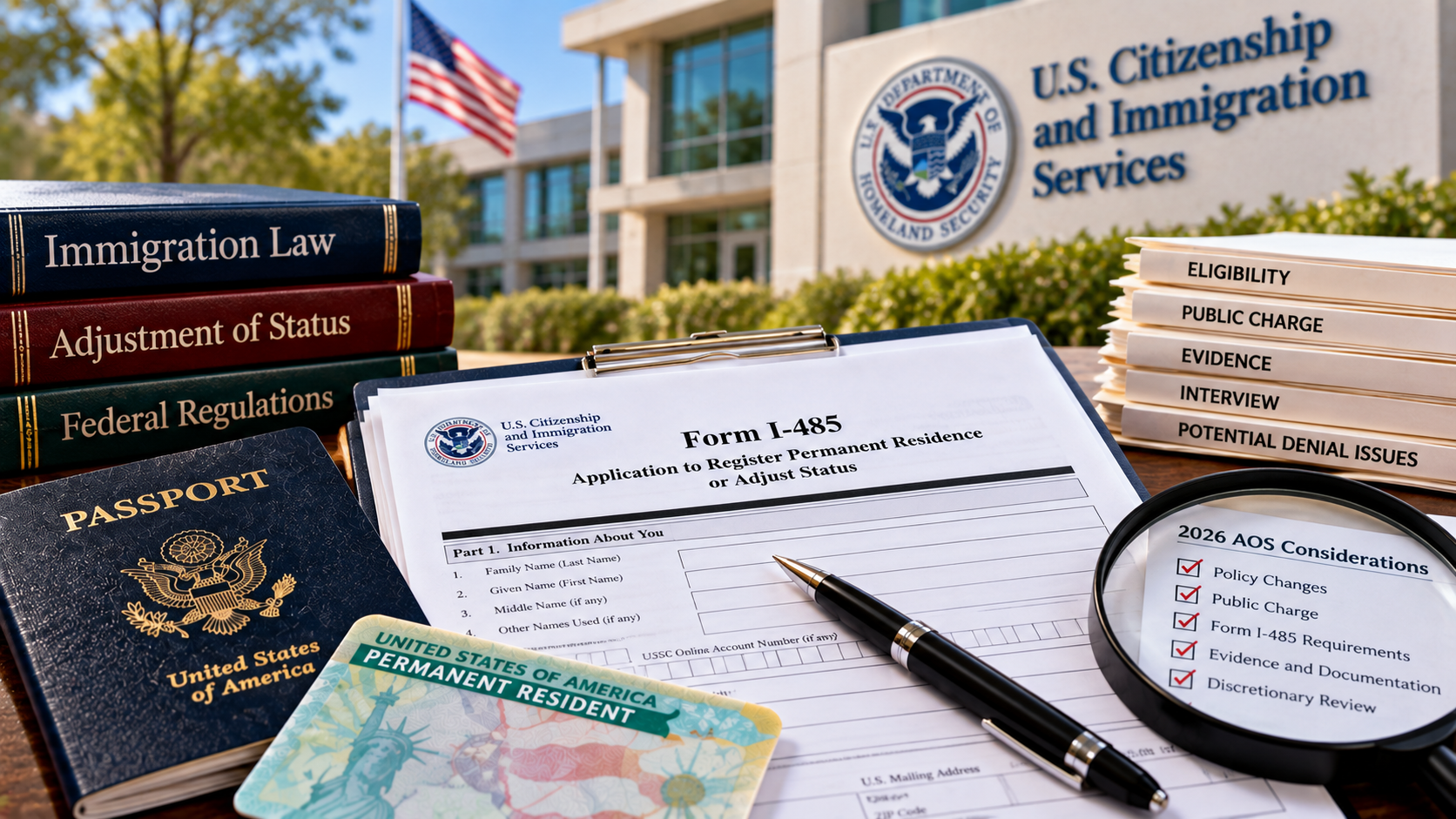
Is Adjustment of Status Harder in 2026? What Applicants Should Expect
The most accurate answer is: in some ways, yes—but not in every way.
Adjustment of status remains available to eligible applicants, including many spouses, parents, and children of U.S. citizens. Congress has not eliminated the adjustment-of-status process, and the basic statutory requirements for obtaining permanent residence from inside the United States remain in place.
In fact, USCIS’s own national statistics show that family-based Form I-485 cases have been moving faster in 2026 than they did during the previous several years.
At the same time, several significant policy changes have made the process more complicated and potentially more consequential for certain applicants.
USCIS has placed greater emphasis on the discretionary nature of adjustment of status. A new public-charge framework took effect on September 18, 2026. USCIS introduced a new edition of Form I-485 with no grace period for older editions. And under USCIS’s current Notice to Appear policy, an unsuccessful immigration application can carry additional consequences for applicants who are not lawfully present in the United States.
So the real question is not simply whether adjustment of status has become “harder.”
The better question is: What is USCIS looking at in 2026, and how should applicants prepare their cases differently?
For a broader explanation of adjustment eligibility and the Form I-485 process, applicants can also review our Complete Guide to I-485, Adjustment of Status.
KEY TAKEAWAYS
- Adjustment of status is still available in 2026 to applicants who satisfy the applicable legal requirements.
- Family-based I-485 cases are actually moving faster nationally than they did in recent fiscal years.
- USCIS has placed greater emphasis on adjustment of status as a discretionary benefit, meaning technical eligibility does not necessarily end the analysis.
- A new public-charge framework took effect on September 18, 2026 and may affect many family-based applicants.
- USCIS now requires the 09/18/26 edition of Form I-485 for new filings and rejects older editions submitted on or after September 18, 2026.
- A denied immigration benefit request can carry additional consequences for an applicant who is not lawfully present in the United States.
- The practical result is that applicants should identify potential eligibility, admissibility, evidentiary, and discretionary problems before filing.
Adjustment of Status Is Not Necessarily Taking Longer
One important point often gets lost when people say that adjustment of status has become more difficult.
USCIS’s published processing statistics show that family-based adjustment cases have actually been moving faster nationally.
For fiscal year 2026 through July 31, 2026, USCIS reported a national median processing time of approximately six months for family-based Form I-485 applications.
By comparison, USCIS reported a national median of approximately 7.4 months in fiscal year 2025 and 8.9 months in fiscal year 2024.
That does not mean every case will be completed within six months.
Processing times can vary based on the USCIS field office, whether an interview is required, whether USCIS requests additional evidence, whether the underlying immigrant petition remains pending, background checks, and issues particular to the applicant’s case.
A case involving a Request for Evidence, questions regarding admissibility, complicated immigration history, or additional investigation can take substantially longer.
But the national data demonstrate an important distinction: “harder” does not necessarily mean “slower.”
USCIS Is Emphasizing Discretion More Heavily
One of the most significant developments came in May 2026, when USCIS issued Policy Memorandum PM-602-0199 concerning adjustment of status.
The memorandum emphasizes that adjustment of status is discretionary and describes the benefit as a form of administrative grace that permits an applicant to obtain permanent residence without completing the ordinary immigrant visa process through a U.S. consulate abroad.
That does not mean that adjustment of status has disappeared or that USCIS can disregard the eligibility requirements established by Congress.
An applicant must still satisfy the applicable statutory requirements for adjustment of status.
But satisfying those threshold requirements does not necessarily end USCIS’s analysis. The agency may also determine whether the applicant warrants a favorable exercise of discretion.
This makes it increasingly important to review the applicant’s immigration history as a whole rather than treating Form I-485 as simply a paperwork exercise.
What Can Matter in a Discretionary Review?
The answer depends on the individual case.
USCIS may consider both favorable and unfavorable circumstances when exercising discretion. Depending on the applicant, this can involve immigration history, compliance with immigration laws, family and community ties, humanitarian circumstances, conduct, prior violations, and other relevant facts.
This does not mean that every visa overstay or immigration violation automatically results in denial.
Congress specifically exempted certain applicants—such as immediate relatives of U.S. citizens—from some adjustment bars involving failure to maintain lawful status and unauthorized employment.
But an exemption from one statutory bar does not necessarily mean that every aspect of the applicant’s immigration history becomes irrelevant.
The September 18 Public-Charge Changes Added Another Layer of Review
Another major change took effect on September 18, 2026.
DHS rescinded the public-charge regulations that had been in place since 2022 and restored a broader framework for determining whether certain applicants are likely at any time to become a public charge.
For applicants subject to the public-charge ground of inadmissibility, USCIS may consider factors including:
- age;
- health;
- family status;
- assets, resources, and financial status;
- education and skills; and
- other relevant circumstances.
The new framework also permits consideration of a broader range of means-tested public benefits received on or after September 18, 2026 as part of the totality of the circumstances.
This does not mean that receiving a public benefit automatically results in denial.
It does mean that financial circumstances can require substantially more attention in covered adjustment cases than they did under the narrower 2022 framework.
Applicants can read more about this issue in our 2026 Public Charge Rule for Adjustment of Status article.
Technical Filing Requirements Matter More Than Applicants May Realize
An adjustment case can run into problems before USCIS ever reaches the legal merits if the application itself is not properly filed.
USCIS introduced a new edition of Form I-485 dated 09/18/26 to correspond with the new public-charge framework.
There was no grace period for the older editions.
For applications postmarked or electronically submitted on or after September 18, 2026, USCIS accepts only the current 09/18/26 edition and rejects the prior editions.
USCIS also requires Form I-693, Report of Immigration Medical Examination and Vaccination Record, to accompany Form I-485 when the medical examination is required. USCIS warns that failure to submit a required Form I-693 with the adjustment application may result in rejection.
Applicants should therefore verify the current form edition, signatures, supporting forms, fees, and filing instructions immediately before submitting the application.
A form downloaded several months earlier should not automatically be assumed to remain current.
DID YOU KNOW?
A pending Form I-485 does not necessarily mean that an applicant has an independent lawful immigration status.
This distinction can become extremely important if USCIS denies the adjustment application.
Under USCIS's current Notice to Appear policy, the agency directs issuance of an NTA in certain circumstances when USCIS issues an unfavorable decision on an immigration benefit request and the individual is not lawfully present in the United States.
That does not mean that every denied Form I-485 automatically results in immigration court proceedings. The applicant's immigration status, prior proceedings, grounds of removability, and other circumstances can affect what happens next.
But applicants who have overstayed a visa, no longer have another lawful immigration status, or have other immigration complications should understand the potential consequences of an unsuccessful application before filing.
In 2026, the analysis should include not only whether USCIS may approve the case, but also what the applicant's immigration position would be if USCIS denies it.
Does This Mean USCIS Is Denying More Adjustment Cases?
Not necessarily.
There is an important difference between identifying policies that can make the adjustment process more demanding and claiming that USCIS is denying every type of adjustment case at a higher rate.
Applicants should be cautious about drawing nationwide conclusions from individual stories, social media posts, or the experience of a friend or relative.
USCIS publishes processing statistics, but processing speed alone does not establish whether officers are applying greater scrutiny to every category of case or whether denial rates have increased across all family-based adjustment applications.
What can be said with confidence is that several policies and filing changes now require applicants to pay closer attention to issues that may materially affect the case.
Marriage-Based Cases Still Depend Heavily on the Facts
For marriage-based applicants, one of the most important issues remains whether the marriage is bona fide.
A marriage certificate establishes that a legal marriage occurred. It does not, by itself, establish that the couple entered into the marriage in good faith rather than primarily to obtain an immigration benefit.
USCIS may consider evidence showing that the couple actually shares a life together.
That can include joint financial records, housing records, insurance, photographs, travel, correspondence, children, affidavits, and many other forms of evidence depending on the couple’s circumstances.
But applicants should also understand that there is no single document that every legitimate married couple must possess.
For example, an immigrant spouse who does not yet have a Social Security number may have difficulty being added to certain financial accounts or obtaining credit. Other couples may live with parents or other family members and therefore have no traditional joint lease or mortgage.
The absence of one particular type of document does not automatically mean the marriage is fraudulent.
The evidence should be evaluated as a whole and in the context of how the couple actually lives.
USCIS Can Review the Applicant’s Entire Immigration History
Another common mistake is preparing Form I-485 as though it exists in isolation.
USCIS may already possess records from prior visa applications, petitions, immigration filings, border encounters, previous interviews, employment authorization applications, immigration proceedings, or other interactions with the government.
Applicants should therefore review their prior immigration history before answering the current Form I-485.
A discrepancy does not automatically mean USCIS will deny the case.
But an inconsistency involving entry history, prior marriages, employment, criminal history, immigration status, previous representations to the government, or another significant fact may require explanation.
The better approach is to identify those issues before the application is submitted instead of discovering them for the first time during the USCIS interview or after receiving a Request for Evidence or Notice of Intent to Deny.
So, Is Adjustment of Status Harder in 2026?
In some respects, yes.
The process is not necessarily slower. USCIS’s national processing statistics actually show that family-based adjustment cases have been moving faster in 2026 than during recent fiscal years.
Congress also has not eliminated the statutory path to adjustment of status for eligible applicants.
What has changed is the environment surrounding the application.
USCIS is emphasizing discretionary review. Public charge has become more significant for covered applicants. Filing requirements have changed. And an unsuccessful benefit application can carry greater consequences for a person who does not have another lawful immigration status to fall back on.
That makes pre-filing analysis increasingly important.
What Should Applicants Expect Before Filing?
Applicants should expect to do more than simply complete the forms.
Before filing, it may be necessary to review:
- how the applicant entered the United States;
- whether the applicant was inspected and admitted or paroled;
- current and prior immigration status;
- visa overstays or unauthorized employment;
- prior immigration applications and petitions;
- criminal arrests, citations, or convictions;
- possible fraud or misrepresentation issues;
- prior immigration proceedings or removal orders;
- financial sponsorship and public-charge concerns;
- the current Form I-485 and supporting-document requirements; and
- for marriage-based cases, the evidence establishing a bona fide marriage.
Not every issue on that list prevents adjustment of status.
Some applicants are expressly exempt from particular adjustment bars. Some grounds of inadmissibility may have waivers. Other facts that initially appear concerning may not create a legal problem after the applicable law is reviewed.
The important point is to know what the issue is before USCIS identifies it.
Adjustment of status remains a viable path to permanent residence in 2026. But applicants should approach it as a legal case—not simply as a paperwork package.
This article reflects USCIS policies, regulations, and published processing data available as of October 4, 2026.
How GS LAW Can Help
Adjustment of status remains available to eligible applicants in 2026, but the current USCIS environment makes careful preparation increasingly important.
GS LAW, APC assists individuals and families with adjustment-of-status matters, including marriage-based Green Card applications.
Our review can address inspection and admission or parole, visa overstays, immigration history, prior filings, Form I-130, Form I-485, Form I-864 sponsorship requirements, public-charge concerns, criminal or admissibility issues, bona fide marriage evidence, and preparation for USCIS interviews.
We can also identify potential problems before filing and evaluate whether an adjustment bar, ground of inadmissibility, exception, waiver, or other provision of immigration law may affect the case.
If you are considering adjustment of status under the current 2026 rules, contact GS LAW, APC to schedule an immigration consultation.