My Adjustment of Status Filing Was Rejected: What Should I Do Next?
You mailed your adjustment-of-status package to USCIS.
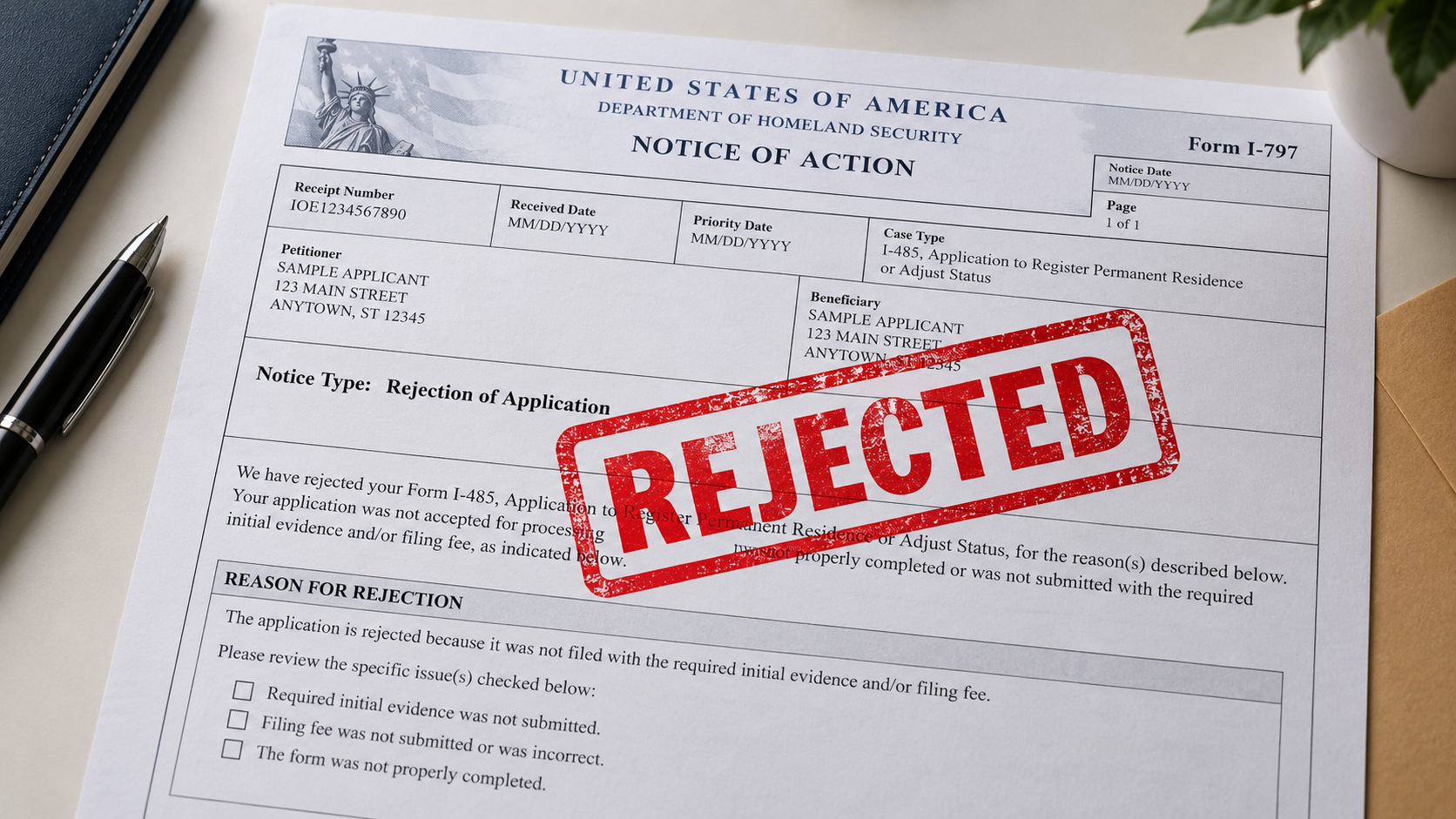
A few weeks later, instead of receiving receipt notices, the entire package came back with a rejection notice.
What happened?
The first thing to understand is that a rejected Form I-485 is not the same thing as a denied Form I-485.
A denial generally means USCIS accepted the application for processing, reviewed the case, and ultimately decided that the applicant did not establish eligibility for adjustment of status.
A rejection usually occurs much earlier in the process. USCIS has determined that the application cannot be accepted for filing because something about the submission does not satisfy the filing requirements.
Common problems can include an incorrect form edition, a missing signature, an incorrect filing fee, missing pages, pages from different editions of the form, or failure to include another document that USCIS currently requires at the time of filing.
In many cases, the problem can be corrected and the application can be submitted again.
But applicants should not simply put the same package into another envelope and mail it back.
A rejected application should be reviewed carefully before it is resubmitted because the rejection may affect the filing date, and the original problem may not be the only issue with the case.
KEY TAKEAWAYS
- A USCIS rejection is different from a denial on the merits of the adjustment-of-status application.
- A rejected Form I-485 generally has not been accepted as a properly filed adjustment application.
- Read the USCIS rejection notice carefully before changing anything in the package.
- Common rejection problems include an outdated form edition, missing signatures, incorrect fees, missing pages, mixed form editions, and failure to include a required Form I-693.
- As of September 18, 2026, USCIS requires the 09/18/26 edition of Form I-485 for new filings submitted on or after that date.
- Correcting the filing defect does not necessarily mean that the underlying adjustment case is legally approvable.
- A rejected application may lose an important filing date, so applicants with time-sensitive eligibility issues should act promptly.
- If USCIS appears to have rejected the filing incorrectly, the rejection should be reviewed rather than blindly changing a filing that may already have been correct.
First: Determine Why USCIS Rejected the Application
Do not begin by guessing.
USCIS normally returns a rejection notice explaining why the filing was not accepted.
Start with that notice.
Then compare the stated rejection reason against the actual package that was submitted.
Sometimes the problem is obvious. Other times, the applicant may believe everything was submitted correctly and the reason for rejection requires closer examination.
Common Reason #1: You Used the Wrong Edition of Form I-485
This is particularly important in 2026.
USCIS introduced a new edition of Form I-485 dated 09/18/26 in connection with the new public-charge rules.
There is no grace period for the older Form I-485 editions.
For applications postmarked or electronically submitted on or after September 18, 2026, USCIS will reject the older 01/20/25 and 09/04/26 editions.
This means that an applicant who downloaded Form I-485 several months earlier may unknowingly be filing a version that USCIS no longer accepts.
Before resubmitting, download the current version directly from USCIS and verify the edition date printed at the bottom of every page.
Make Sure Every Page Is From the Same Edition
Do not simply replace the first page of an old application with the first page of a newer form.
USCIS warns that missing pages or pages from different editions can result in rejection.
If a new edition is required, the safer approach is generally to prepare the application using the complete current edition.
Common Reason #2: A Required Signature Is Missing
An unsigned immigration form can be rejected.
This sounds simple, but an adjustment package may contain multiple forms requiring signatures from different people.
Depending on the filing, signatures may be required from the adjustment applicant, petitioner, financial sponsor, household member, interpreter, preparer, or another person completing a particular form.
Before resubmitting, review every form in the package individually.
Do not assume that fixing the signature on Form I-485 resolves a missing signature somewhere else in the package.
Common Reason #3: The Filing Fee Was Incorrect
USCIS requires the correct filing fee unless a particular exemption or fee-waiver provision applies.
An incorrect fee can result in rejection.
Filing fees and payment rules change, so applicants should verify the current USCIS fee schedule immediately before resubmitting rather than relying on an amount found in an old article, checklist, or previously prepared package.
The same principle applies when several applications are being filed together.
For example, an adjustment package may include Form I-485 and additional applications or petitions, each of which may have its own filing-fee requirements.
Common Reason #4: The Required Medical Examination Was Not Included
USCIS currently requires applicants who must submit Form I-693, Report of Immigration Medical Examination and Vaccination Record, to submit it with Form I-485.
If a required Form I-693 is omitted, USCIS may reject Form I-485.
This is different from the practice that existed in earlier years when many applicants could file Form I-485 first and provide the medical examination later.
Applicants relying on an old adjustment-of-status checklist may therefore encounter problems under the current filing rules.
What If USCIS Opened the I-693 Envelope Before Returning the Package?
USCIS specifically addresses this situation.
If USCIS rejects the package and returns the original Form I-693 with the medical envelope opened, USCIS states that the applicant may resubmit that original opened Form I-693 with the new Form I-485 package.
The applicant should include the supporting materials that had been inside the civil surgeon’s original envelope and a copy of the USCIS rejection notice.
Do not assume that your original mailing date has been preserved simply because USCIS physically received the rejected package.
A rejected Form I-485 generally has not been accepted as a properly filed adjustment application.
This distinction can become extremely important when eligibility depends on timing.
For example, an applicant may be dealing with visa availability, expiration of another immigration status, age-related eligibility, a filing deadline, or another circumstance where the actual filing date matters.
The applicant also should not assume that a rejected I-485 created a pending adjustment case merely because the package spent several weeks at a USCIS Lockbox.
If the filing date is legally important, determine the consequences of the rejection before simply correcting the paperwork and mailing it again.
Should You Just Correct the Error and Mail the Same Package Back?
Sometimes that may be appropriate.
If the rejection involves a straightforward filing defect—such as a missing signature or incorrect fee—the problem may be relatively easy to correct.
But a rejected application also creates an opportunity to review the entire case before resubmitting it.
That can be especially important if the original application was prepared without a detailed review of the applicant’s immigration history.
Before resubmitting, verify:
- that the current Form I-485 edition is being used;
- that every page belongs to the same edition;
- that all required signatures are present;
- that the current filing fees and payment requirements are satisfied;
- that the filing address is current;
- that Form I-693 is included when required;
- that all required supporting forms are included;
- that the information on the forms is accurate and internally consistent; and
- that the applicant is actually eligible to seek adjustment of status.
A Rejection Does Not Mean USCIS Approved the Legal Theory Behind the Case
This is an important distinction.
A USCIS Lockbox performs an intake function.
If an application is accepted and receipt notices are issued, that does not mean USCIS has concluded that the applicant is legally eligible for permanent residence.
Likewise, if an application is rejected because of a fee or signature problem, correcting that problem does not answer the substantive immigration questions.
Before resubmitting, applicants should still consider issues such as:
- whether the applicant was inspected and admitted or paroled;
- whether an adjustment bar applies;
- whether INA Section 245(i) may be required;
- whether there is a criminal or immigration history issue;
- whether fraud or misrepresentation may be involved;
- whether prior removal proceedings exist;
- whether public charge is an issue;
- whether the financial sponsorship is sufficient; and
- whether the underlying family or employment petition supports adjustment.
The goal should not simply be to get the package through the mailroom.
The goal should be to file an adjustment case that is both procedurally acceptable and legally supportable.
What If USCIS Rejected the Application by Mistake?
USCIS Lockboxes can make mistakes.
If the rejection notice says that a signature, fee, form, or other filing requirement was missing but the applicant believes the package actually complied with the requirement, review the returned filing carefully before changing anything.
For Lockbox-related rejection issues, USCIS has instructed filers to contact Lockbox Support when they believe a filing was incorrectly rejected.
Depending on the circumstances, the applicant may still decide to resubmit promptly while separately addressing the incorrect rejection.
The appropriate response can depend on whether the filing date is important and how quickly the application needs to be accepted.
Should You Include the Rejection Notice When You Resubmit?
In many situations, keeping the rejection notice with the corrected filing is useful because it shows USCIS that the package is a resubmission and identifies what happened to the original filing.
USCIS specifically requires a copy of the rejection notice in certain resubmission situations, including when USCIS opened and returned the original Form I-693 envelope.
The applicant should preserve a complete copy of the rejection notice and the package that was returned.
Do not throw away the rejection notice after identifying the apparent problem.
Do Not Wait Too Long to Fix a Rejected Filing
A rejection should be addressed promptly.
Even when the defect seems minor, the passage of time can matter.
Visa availability can change. Forms and fees can change. Immigration status can expire. A child can age. Other facts affecting eligibility can change while the applicant is waiting to refile.
This does not mean the package should be rushed back to USCIS without review.
It means the applicant should promptly determine why the filing was rejected, whether the stated reason is correct, whether anything else needs to be fixed, and whether timing affects the case.
Rejection Can Actually Be an Opportunity to Catch a Bigger Problem
A rejected filing is frustrating, but it can sometimes provide an unexpected opportunity.
USCIS has not yet adjudicated the adjustment application on the merits.
Before sending the package back, an applicant has an opportunity to review the application again and identify problems that may have nothing to do with the rejection notice.
For example, the applicant may discover an incorrect entry date, an omitted arrest, inconsistent information from a prior immigration filing, an insufficient Affidavit of Support, missing marriage evidence, or another issue that would have become more difficult to address after USCIS accepted the application.
The right response to a rejected I-485 is not simply, “How do I get USCIS to accept this package?” It is, “Why was it rejected, what needs to be corrected, and is the entire case ready to be filed?”
This article reflects USCIS filing requirements available as of October 4, 2026.
How GS LAW Can Help
A rejected adjustment-of-status filing does not necessarily mean that the applicant is ineligible for a Green Card.
GS LAW, APC can review the USCIS rejection notice, determine why the filing was returned, and evaluate what must be corrected before the application is resubmitted.
Our review can also go beyond the technical rejection issue and examine the underlying adjustment case, including admission or parole, immigration history, prior filings, Form I-130, Form I-485, Form I-693, Form I-864 sponsorship requirements, public-charge concerns, criminal or admissibility issues, and marriage evidence.
If USCIS appears to have rejected the filing incorrectly, we can also evaluate whether the issue should be raised with USCIS while protecting any time-sensitive filing concerns.
The objective is not merely to get the package accepted at the Lockbox. It is to make sure the adjustment-of-status case is properly prepared before it goes back to USCIS.
If USCIS rejected your Form I-485 or returned your adjustment-of-status package, contact GS LAW, APC to schedule an immigration consultation.