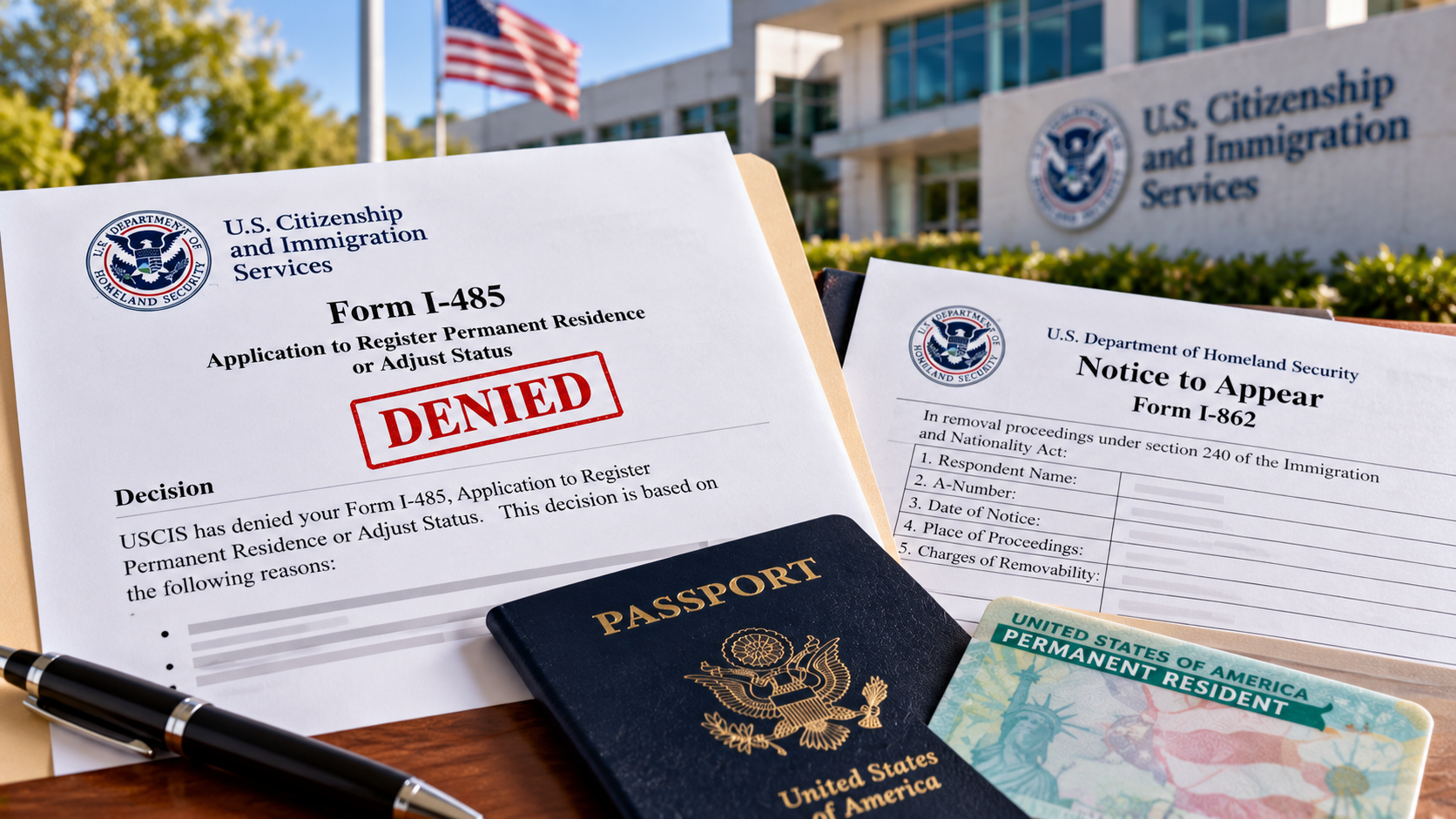
Adjustment of Status Denial and Notice to Appear in 2026
For many adjustment-of-status applicants, the biggest fear is that USCIS will deny the Green Card application.
In 2026, however, a denial can raise another important question:
Can USCIS issue a Notice to Appear and send the applicant to immigration court after denying Form I-485?
For some applicants, the answer is yes.
Under USCIS’s current Notice to Appear policy, USCIS states that it will issue a Notice to Appear, commonly called an NTA, when it issues an unfavorable decision on an immigration benefit request and the person is not lawfully present in the United States.
That makes it particularly important for adjustment applicants to understand their immigration status and potential grounds of inadmissibility or removability before filing Form I-485.
At the same time, an adjustment denial does not automatically mean that every applicant will receive an NTA, and receiving an NTA does not mean that a person has already been ordered removed from the United States.
The consequences depend heavily on the applicant’s particular immigration history and legal status.
For a broader discussion of the adjustment process, applicants can also review our Complete Guide to I-485, Adjustment of Status.
KEY TAKEAWAYS
- A Form I-485 denial does not automatically result in an NTA in every case.
- Under current USCIS policy, USCIS states that it will issue an NTA after an unfavorable benefit decision when the applicant is not lawfully present in the United States.
- An applicant who independently maintains lawful immigration status may be situated differently from an applicant whose only basis for remaining in the United States was a pending adjustment application.
- A Notice to Appear is the charging document used to place a person into removal proceedings; it is not itself a final order of removal.
- There generally is no administrative appeal from the denial of Form I-485, although a motion to reopen or reconsider may be available depending on the circumstances.
- The safest time to identify potential adjustment-of-status problems is before Form I-485 is filed.
What Happens When USCIS Denies Form I-485?
When USCIS denies an adjustment-of-status application, the agency issues a written decision explaining why the application was denied.
The reason for denial matters.
An I-485 can be denied for many different reasons. Depending on the case, USCIS may determine that the applicant failed to establish eligibility for adjustment, is inadmissible to the United States, failed to provide required evidence, failed to appear for an interview, or did not establish a required factual element of the case.
In a marriage-based case, for example, USCIS may conclude that the applicant failed to establish a bona fide marriage. In another case, USCIS may determine that the applicant did not establish inspection and admission or parole. Other cases may involve criminal history, fraud or misrepresentation, financial sponsorship, public charge, or other admissibility issues.
The denial ends the pending Form I-485 unless USCIS later reopens or reconsiders the decision.
Can USCIS Issue an NTA After Denying Adjustment of Status?
Yes.
USCIS revised its Notice to Appear policy in 2025. Under the current policy, USCIS states that it will issue an NTA when the agency issues an unfavorable decision on an immigration benefit request and the person is not lawfully present in the United States.
That policy can be extremely important in adjustment-of-status cases.
Many adjustment applicants do not independently maintain another immigration status while Form I-485 is pending.
For example, a person may have originally entered the United States as a visitor, remained beyond the expiration of the authorized stay, later married a U.S. citizen, and then filed Form I-485.
Whether that applicant qualifies for adjustment is a separate legal question. But if USCIS ultimately denies the I-485 and the applicant does not have another lawful basis to remain in the United States, the possibility of an NTA must be taken seriously.
Does Every I-485 Denial Result in an NTA?
No.
The immigration consequences of an I-485 denial depend on the applicant’s circumstances.
Some applicants may still independently hold valid immigration status when USCIS denies the adjustment application.
For example, an applicant may have filed Form I-485 while continuing to maintain a valid nonimmigrant classification. If the I-485 is denied but that lawful status remains valid, the denial does not necessarily place the applicant in the same position as someone who has no remaining lawful immigration status.
Other applicants may have separate grounds of removability, prior immigration proceedings, prior removal orders, criminal issues, fraud or misrepresentation concerns, or other circumstances that can change the analysis.
The important point is that applicants should not assume either that an NTA is automatic in every denied adjustment case or that an NTA is impossible because the case was originally filed with USCIS.
What Is a Notice to Appear?
A Notice to Appear is Form I-862.
It is the charging document DHS uses to allege that a person is removable from the United States.
The NTA generally identifies factual allegations concerning the person’s immigration history and one or more legal charges explaining why DHS believes the person is removable.
Receiving an NTA does not by itself mean that an immigration judge has ordered the person removed.
Removal proceedings formally begin when DHS files the NTA with the immigration court after serving it on the individual.
The immigration judge then determines the issues presented in the removal proceedings, including whether the person is removable and whether any available relief or protection may apply.
CAUTION
Do not assume that filing Form I-485 gives you lawful immigration status that continues if USCIS denies the application.
A pending adjustment application and lawful immigration status are not necessarily the same thing.
This distinction can become extremely important after a denial. If an applicant has no independent lawful basis to remain in the United States when USCIS issues an unfavorable decision, USCIS's current NTA policy may require issuance of a Notice to Appear.
For applicants with an overstay, unlawful entry, previous immigration case, prior removal order, criminal history, or other potentially significant immigration issue, the consequences of filing should be analyzed before the application is submitted.
An NTA Does Not Mean You Have Already Been Ordered Deported
This distinction is important.
An NTA begins the process of bringing the case before an immigration judge. It does not itself constitute a final order of removal.
The NTA contains factual allegations and legal charges explaining why DHS believes the individual is removable.
At the immigration court, the respondent has an opportunity to address those allegations and charges. Depending on the circumstances, there may also be applications or legal arguments that can be presented before the immigration judge.
Applicants should therefore avoid treating the words “Notice to Appear” as though they mean USCIS has already entered a final deportation order.
Can You Appeal a Denied Form I-485?
Generally, there is no administrative appeal from USCIS’s denial of Form I-485.
That does not necessarily mean that nothing can be done.
Depending on the reason for denial and the procedural circumstances, an applicant may be able to file a motion asking USCIS to reopen or reconsider its decision.
Motion to Reopen
A motion to reopen generally relies on new facts and supporting evidence that were not adequately considered in the original adjudication.
For example, an applicant may contend that USCIS denied the case because necessary evidence was missing and may seek reopening based on evidence addressing that issue.
Motion to Reconsider
A motion to reconsider generally argues that USCIS incorrectly applied the law or policy based on the record that existed when the original decision was issued.
Whether either motion is available or advisable depends on the specific denial notice and circumstances of the case.
The applicant should review the actual USCIS decision immediately because immigration motions are subject to filing requirements and deadlines.
Can You Simply File a New I-485?
Sometimes a new filing may be possible, but refiling should not be treated as an automatic solution.
The first question should be why USCIS denied the original application.
If the first I-485 was denied because the applicant was legally ineligible to adjust status, submitting the same application again without resolving the underlying problem may simply produce another denial.
If the denial resulted from a curable filing or evidentiary problem, the analysis may be different.
Applicants should therefore determine whether the problem involved eligibility, inadmissibility, missing evidence, an underlying immigrant petition, a procedural mistake, or some other issue before deciding whether to refile.
Why Pre-Filing Review Matters More Under the Current NTA Policy
The current enforcement environment changes the risk calculation for some adjustment applicants.
Historically, some applicants may have viewed the worst possible result of an unsuccessful adjustment filing as simply receiving a denial and losing the filing fees.
That assumption should not be made in 2026.
Before filing, an applicant should understand whether there are issues concerning:
- inspection and admission or parole;
- prior overstays or status violations;
- prior immigration proceedings or removal orders;
- previous immigration applications or inconsistent information;
- fraud or misrepresentation;
- criminal arrests, charges, or convictions;
- public-charge concerns;
- financial sponsorship;
- the validity of the underlying immigrant petition; and
- in marriage cases, whether sufficient evidence exists to establish a bona fide marriage.
Not every issue on that list prevents adjustment of status.
Some issues have statutory exceptions. Others may have waivers. Some may not create a legal problem at all after the facts and applicable law are examined.
But identifying the issue after USCIS has already denied the application can place the applicant in a much more difficult position than identifying it before filing.
What Should You Do If USCIS Denies Your I-485?
The first step is to carefully review the written decision.
The denial notice should identify USCIS’s reasons for denying the application. Those reasons determine what options may exist afterward.
Applicants should also determine whether they currently have another lawful immigration status, whether USCIS has issued or may issue an NTA, whether a motion to reopen or reconsider is available, and whether filing a new adjustment application would actually cure the reason for denial.
Simply filing another application without understanding why the first case failed can make the situation worse.
The key question after an I-485 denial is not merely, “Can I file again?” It is, “Why was I denied, what is my immigration position now, and what legally available options address the actual reason for the denial?”
This article reflects USCIS and EOIR policy and guidance available as of October 4, 2026. Immigration policies can change, and applicants should verify current requirements before taking action.
How GS LAW Can Help
An adjustment-of-status application should be evaluated before it is filed, particularly when the applicant has an overstay, complicated immigration history, prior immigration applications, criminal history, admission or parole issues, or another fact that could affect eligibility or admissibility.
GS LAW, APC assists individuals and families with adjustment-of-status matters, including marriage-based Green Card applications. Our review can address eligibility for adjustment, admission or parole, immigration history, prior filings, Form I-130, Form I-485, Form I-864 sponsorship requirements, public-charge concerns, marriage evidence, criminal or admissibility issues, and preparation for USCIS interviews.
We can also review a USCIS adjustment-of-status denial to determine the stated basis for the decision and evaluate whether a motion, corrected filing, new application, or another legally available option should be considered.
If you are considering adjustment of status—or USCIS has already denied your Form I-485—contact GS LAW, APC to schedule an immigration consultation.
Where a potential issue exists, identifying it before filing can allow the applicant to understand the risk, determine whether additional evidence is needed, and evaluate whether an exception, waiver, or other legal strategy may apply. If you are considering filing for adjustment of status in 2026, contact GS LAW, APC to schedule an immigration consultation.