Adjustment of Status After September 18, 2026: What Changed?
If you are preparing to apply for a Green Card through adjustment of status, September 18, 2026 is an important dividing line.
On that date, several significant changes took effect that directly affect Form I-485 filings. USCIS began requiring a new edition of Form I-485 with no grace period for older editions. At the same time, a new public-charge framework took effect that gives immigration officers broader discretion when evaluating certain adjustment-of-status applicants.
The changes do not mean that adjustment of status disappeared or that every applicant suddenly faces a new eligibility problem. But anyone filing Form I-485 now should understand that the form, the financial questions, and the public-charge analysis are different from what applied to many applications filed before September 18, 2026.
KEY TAKEAWAYS
- USCIS requires the 09/18/26 edition of Form I-485 for applications postmarked or electronically submitted on or after September 18, 2026.
- USCIS provides no grace period for the older I-485 editions.
- A new public-charge rule also took effect September 18, 2026 and applies to adjustment applications filed on or after that date.
- The new framework allows USCIS officers to consider a broader range of financial circumstances and means-tested public benefits.
- The basic requirements for adjustment of status did not disappear. Applicants must still independently establish eligibility for adjustment and admissibility to the United States.
Why September 18, 2026 Matters
Two major changes occurred at the same time.
First, the Department of Homeland Security’s new Public Charge Ground of Inadmissibility rule became effective on September 18, 2026. The rule rescinded the public-charge regulations that had been in effect since 2022 and restored a broader, more discretionary framework for determining whether an applicant is likely at any time to become a public charge.
Second, USCIS issued a revised Form I-485 specifically designed to implement that new framework.
The effective date matters because DHS expressly made the new rule applicable to adjustment-of-status applications postmarked or electronically submitted on or after September 18, 2026.
For a broader explanation of who may qualify for adjustment of status and how the process normally works, applicants can also review our Complete Guide to I-485, Adjustment of Status.
There Is a New Form I-485—and USCIS Is Rejecting the Old Editions
The easiest change to identify is the form itself.
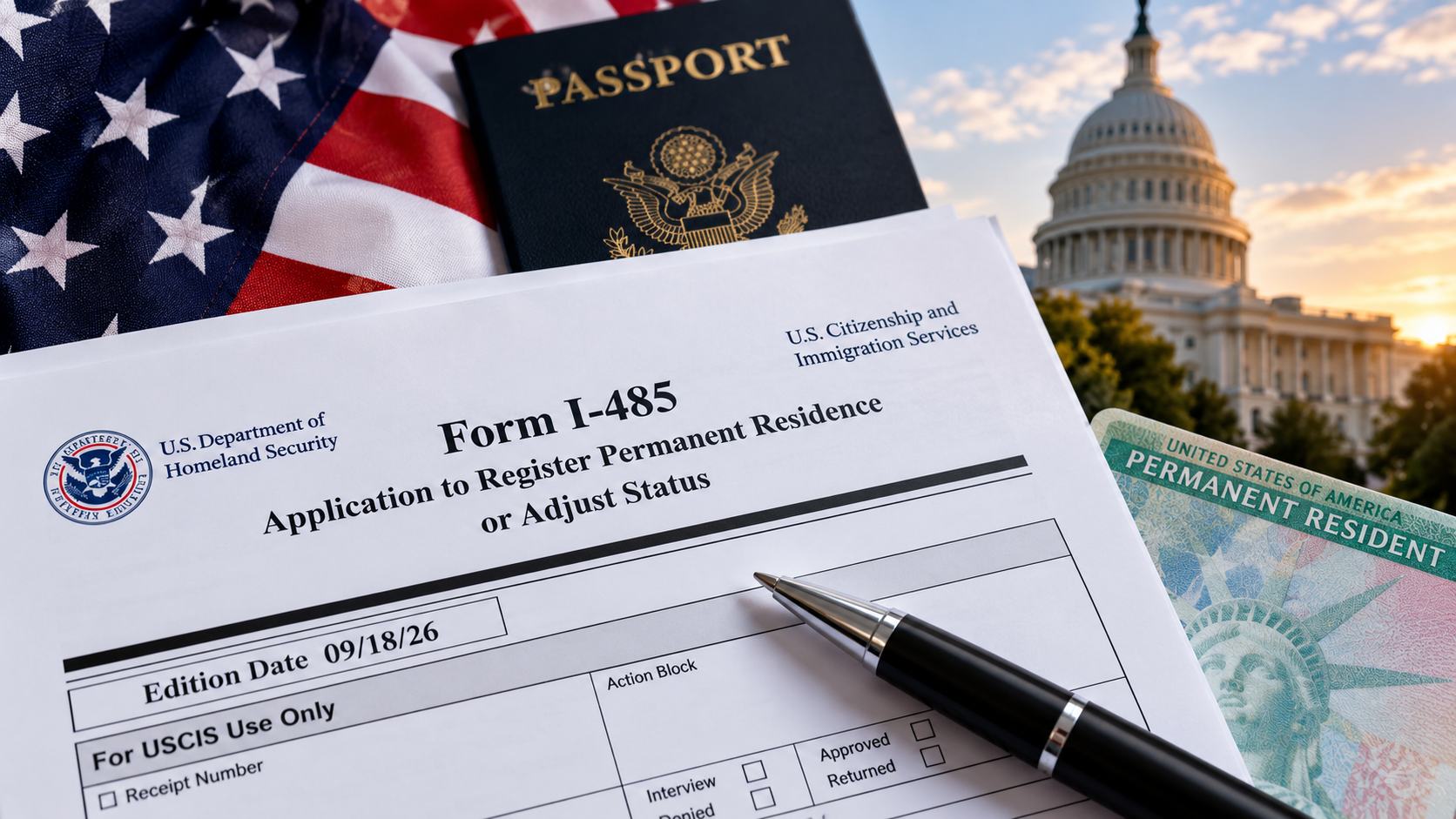
The current Form I-485 carries an edition date of 09/18/26.
USCIS specifically announced that applications postmarked or electronically submitted on or after September 18, 2026 using the older 01/20/25 or 09/04/26 editions will be rejected. USCIS did not provide a transition or grace period.
This is an important distinction between a rejection and a later denial.
A rejection generally means USCIS did not properly accept the application for processing in the first place. That can create significant problems if an applicant was depending on a particular filing date, visa availability, concurrent filing, or another time-sensitive circumstance.
Before submitting an I-485, applicants should therefore verify the edition date printed on the form and make sure pages from different editions have not accidentally been combined. USCIS itself warns that missing pages or pages from different editions may result in rejection.
Filing an Old Copy You Downloaded Months Ago Can Be a Problem
Immigration forms should not simply be saved to a computer and reused indefinitely.
An applicant may have downloaded Form I-485 several months ago, completed most of it, obtained supporting documents, and assumed the application was ready to file.
That assumption can be dangerous when USCIS changes editions.
The version that was correct when the application was first prepared may no longer be accepted on the day it is actually mailed or electronically submitted.
Filing Tip
Always verify the current USCIS form edition immediately before filing.
Do not assume that a form is current merely because it was downloaded from USCIS recently.
A rejected I-485 is not the same thing as a denied I-485.
If USCIS rejects the filing because the wrong edition was used, pages are missing, signatures are omitted, or another filing requirement was not satisfied, USCIS generally treats the application as though it was never properly filed.
That can matter when an applicant is relying on a particular filing date, visa availability, concurrent filing, or another time-sensitive immigration benefit.
Before mailing an adjustment application, verify the current form edition and filing requirements directly with USCIS.
The Public-Charge Analysis Also Changed
The new I-485 edition was not simply a formatting update.
USCIS expressly revised the form to correspond with DHS’s new public-charge rule.
Under immigration law, certain applicants can be found inadmissible if USCIS determines that they are likely at any time to become a public charge. The new 2026 framework requires officers to evaluate the applicant’s circumstances individually rather than applying only the narrower definitions contained in the rescinded 2022 regulations.
USCIS explains that officers must consider five statutory factors:
- the applicant’s age;
- health;
- family status;
- assets, resources, and financial status; and
- education and skills.
Other relevant information may also be considered. In many family-based adjustment cases, Form I-864, Affidavit of Support, is another important component of the analysis.
The public-charge changes are significant enough that we address them separately in our article, The New 2026 Public Charge Rule: What Adjustment of Status Applicants Need to Know.
Public Benefits Are Treated Differently After September 18
One of the most significant changes concerns means-tested public benefits.
Under the prior 2022 framework, the benefits USCIS considered for public-charge purposes were generally limited to public cash assistance for income maintenance and long-term institutionalization at government expense.
Under the new framework, USCIS states that for benefits received on or after September 18, 2026, officers may consider a broader range of means-tested public benefits as part of the totality of the circumstances. USCIS has identified examples including cash assistance for income maintenance, housing assistance, food stamps, financial aid for college, and similar means-tested benefits.
Importantly, receiving a benefit does not necessarily mean that an adjustment application will automatically be denied.
The officer must evaluate the applicant’s circumstances as a whole.
That distinction is important because public-charge determinations are predictive. USCIS is ultimately evaluating whether the person is likely at any time in the future to become a public charge—not merely checking whether the applicant has ever encountered financial difficulty.
Does the New Rule Apply to Everyone Filing for Adjustment of Status?
No.
The public-charge ground does not apply to every immigration category.
However, it generally applies to many applicants seeking permanent residence through family-based immigration, including spouses, children, and parents of U.S. citizens and applicants in family-preference categories.
Congress has also created exemptions for certain immigration categories, particularly some humanitarian and special immigrant classifications.
An applicant should therefore determine first whether the public-charge ground applies to the particular adjustment category before assuming that every question concerning public charge has the same significance in every case.
What About the Affidavit of Support?
The new public-charge rule does not eliminate Form I-864.
Most family-based immigrants are still required to submit a sufficient Affidavit of Support from the petitioning sponsor, unless a statutory exemption applies.
A properly prepared I-864 remains extremely important. But the I-864 and the public-charge analysis should not necessarily be viewed as the same question.
The sponsor may satisfy the I-864 income requirements while USCIS separately examines the intending immigrant’s circumstances under the public-charge ground of inadmissibility.
Applicants who want a more detailed explanation of the sponsorship requirements should review our Complete Guide to Form I-864, Affidavit of Support.
What Did NOT Change on September 18?
It is equally important not to overstate the change.
September 18 did not rewrite every adjustment-of-status requirement.
Applicants must still establish the legal basis for adjustment. Depending on the case, issues may include an approved or concurrently filed immigrant petition, visa availability, inspection and admission or parole, maintenance of status, unauthorized employment, prior immigration violations, criminal history, fraud or misrepresentation, medical grounds, and other grounds of inadmissibility.
Marriage-based applicants must still establish the qualifying marriage and demonstrate that the marriage was entered into in good faith rather than solely to obtain an immigration benefit.
The September 18 changes primarily altered the public-charge framework and the form USCIS uses to collect information relevant to that analysis.
They did not transform an otherwise ineligible applicant into an eligible applicant—or automatically make an otherwise approvable case unapprovable.
What If Your I-485 Was Filed Before September 18, 2026?
The filing date matters.
DHS states that the new public-charge rule applies to adjustment applications postmarked or electronically submitted on or after September 18, 2026. Applications submitted during the period governed by the 2022 regulations remain governed by the applicable prior framework.
For applicants close to the effective date, the actual postmark or electronic submission date can therefore be important.
Do not assume that the date you signed the form or the date you handed documents to someone for preparation determines which rule applies.
Adjustment of Status Is Becoming More Fact-Specific
One practical consequence of the new framework is that applicants should be careful about treating Form I-485 as a simple paperwork exercise.
An adjustment application can require examination of much more than whether every blank on the form contains an answer.
For example, the applicant’s prior immigration history, prior government filings, admission history, criminal record, financial circumstances, public-benefit history, marriage evidence, and answers provided during an interview may all become important depending on the case.
An applicant should understand what USCIS is asking and why the information matters before submitting the application.
How GS LAW Can Help
GS LAW, APC represents individuals and families applying for permanent residence through adjustment of status.
Our review can address whether the public-charge ground applies, the applicant’s financial and benefit history, Form I-864 sponsorship, joint sponsors, household income and assets, the current Form I-485, marriage-based adjustment requirements, and other admissibility or eligibility issues that may affect the Green Card application.
If you are preparing an adjustment-of-status application under the new 2026 public-charge rules—or are concerned about how prior or current public benefits may affect your case—contact GS LAW, APC to schedule an immigration consultation.