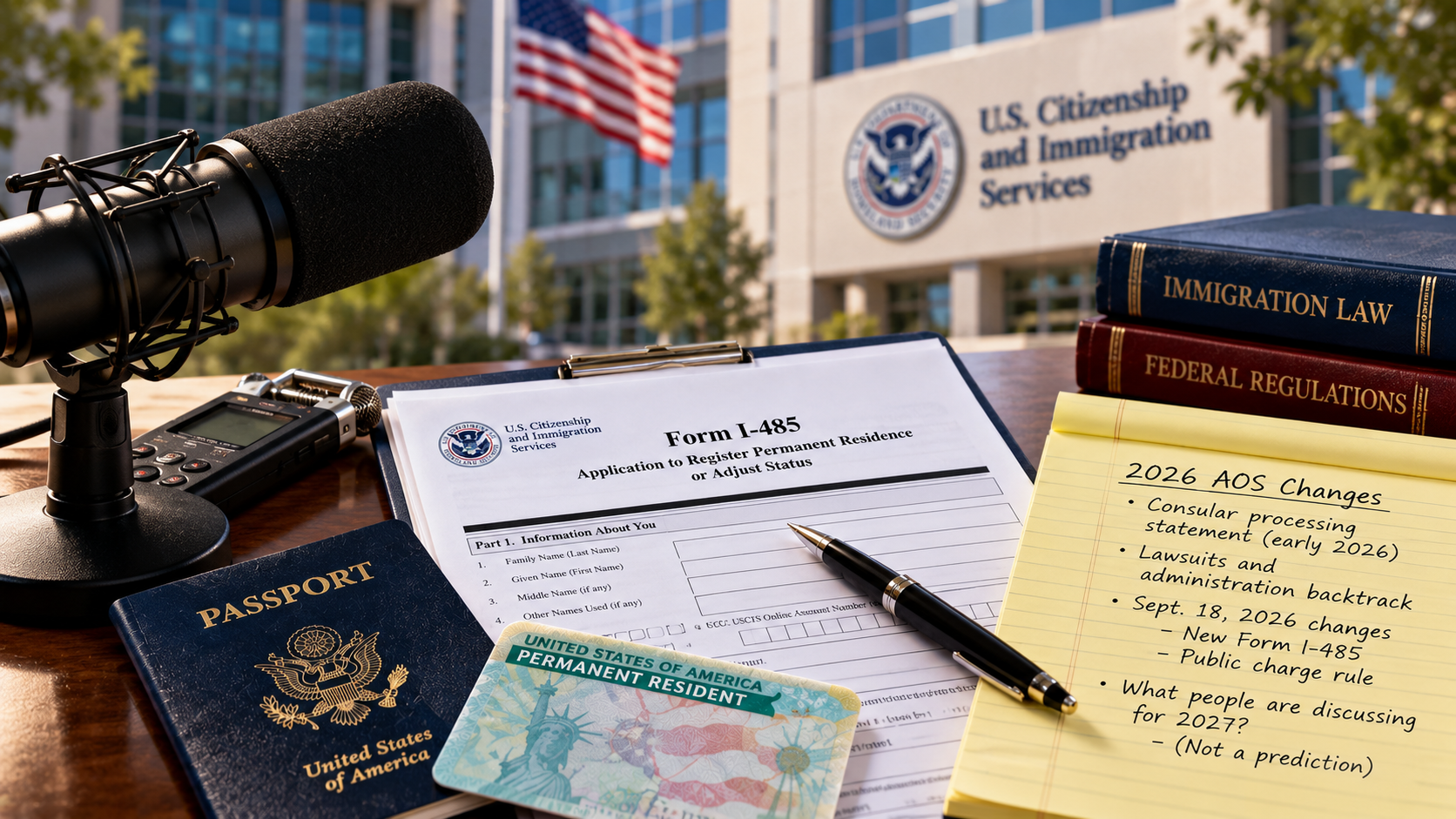
Interview With Immigration Attorney Gabriel Sandoval: How Adjustment of Status Has Changed in 2026
Adjustment of status has gone through several significant changes in 2026, and some of those developments have created considerable confusion for people seeking permanent residence from inside the United States.
Earlier this year, USCIS issued a controversial policy memorandum emphasizing the discretionary nature of adjustment of status and describing consular processing outside the United States as the ordinary process for obtaining an immigrant visa.
The public announcement accompanying that memorandum went even further, stating that a person temporarily in the United States who wanted a Green Card would generally be expected to return to his or her home country to apply, except in extraordinary circumstances.
That announcement immediately raised questions because adjustment of status has long allowed certain eligible applicants to obtain permanent residence without leaving the United States. In some family-based cases, the immigration laws even permit adjustment despite a visa overstay, failure to maintain lawful status, or unauthorized employment.
USCIS and DHS subsequently clarified that adjustment cases would continue to be evaluated individually and that the May policy should not necessarily be understood as a blanket requirement forcing every adjustment applicant to leave the country.
Then, on September 18, 2026, another major set of changes took effect. DHS implemented a new public-charge framework, and USCIS began requiring a new edition of Form I-485.
In this interview, immigration attorney Gabriel Sandoval, founder of GS LAW, APC, discusses what actually changed in 2026, what did not change, and what applicants should—and should not—assume about possible developments in 2027.
KEY TAKEAWAYS
- USCIS issued a new adjustment-of-status policy memorandum in May 2026 emphasizing that approval of Form I-485 is discretionary.
- The accompanying USCIS announcement initially suggested that many people temporarily in the United States should obtain permanent residence through consular processing abroad except in extraordinary circumstances.
- DHS later clarified that adjustment cases would continue to be evaluated individually rather than imposing a blanket requirement that every applicant leave the United States.
- The May memorandum did not repeal INA Section 245 or eliminate adjustment of status.
- On September 18, 2026, a new public-charge framework took effect and USCIS began requiring the new 09/18/26 edition of Form I-485.
- There is currently no announced rule eliminating family-based adjustment of status in 2027.
- Potential future immigration changes should be distinguished from actual rules, proposed regulations, and agency guidance.
Question: What Happened With Adjustment of Status Earlier in 2026?
Gabriel Sandoval: One of the biggest developments came in May 2026, when USCIS issued Policy Memorandum PM-602-0199.
The memorandum emphasized that adjustment of status is discretionary and described it as a form of administrative grace that allows an applicant to obtain permanent residence without going through the ordinary immigrant visa process at a U.S. consulate abroad.
The public announcement accompanying the memorandum was even more aggressive.
USCIS announced that a person who was temporarily in the United States and wanted a Green Card generally would be expected to return to his or her home country to apply, except in extraordinary circumstances.
That understandably caused substantial concern among applicants and immigration attorneys.
Question: Why Was That Announcement Such a Big Deal?
Gabriel Sandoval: Because Congress created adjustment of status precisely as a mechanism through which certain eligible individuals who are already physically present in the United States can obtain permanent residence without necessarily leaving the country for consular processing.
The immigration laws also specifically recognize situations where certain immigration violations do not prevent adjustment of status.
A common example involves an immediate relative of a U.S. citizen.
A spouse of a U.S. citizen who was inspected and admitted into the United States may, depending on the circumstances, still qualify for adjustment of status even after overstaying a visa or failing to maintain lawful immigration status.
Immediate relatives are also exempt from certain adjustment bars involving unauthorized employment.
That does not mean that every person who has accumulated unlawful presence can adjust status.
The manner of entry remains extremely important. Under the general rule in INA Section 245(a), an applicant ordinarily must have been inspected and admitted or inspected and paroled before seeking adjustment of status, unless another statutory provision or exception applies.
Other issues involving criminal history, fraud or misrepresentation, previous immigration proceedings, prior removal orders, unlawful presence, and other grounds of inadmissibility can also completely change the analysis.
Question: Did USCIS Back Away From the May Announcement?
Gabriel Sandoval: To some extent, yes—but it is important to describe exactly what happened.
The initial public announcement made the policy sound extremely broad. It suggested that someone temporarily in the United States who wanted permanent residence generally should leave the country and complete immigrant visa processing abroad unless extraordinary circumstances existed.
Within days, however, DHS representatives clarified that cases would continue to be evaluated individually and described the memorandum as an instruction concerning USCIS officers’ existing discretionary authority.
That substantially softened the broadest interpretation of the original announcement.
But USCIS did not simply erase the May memorandum.
PM-602-0199 remains significant because it emphasizes that an applicant must establish not only technical eligibility for adjustment but also that the case warrants a favorable exercise of discretion.
Question: What About the Lawsuits We Were Hearing About?
Gabriel Sandoval: There was significant legal scrutiny surrounding several USCIS policies during this same period, but we should be careful not to combine separate developments.
In June 2026, a federal court in Rhode Island struck down several separate USCIS policies involving holds on immigration benefit adjudications and country-specific considerations.
USCIS subsequently announced that those particular policies would be treated as though they were no longer in effect while the litigation continued.
The May adjustment-of-status memorandum, PM-602-0199, was not one of the policies vacated in that case.
The memorandum has been raised in other federal litigation, and immigration attorneys have questioned whether portions of the agency’s new approach can be reconciled with the adjustment procedure Congress created.
But it would be inaccurate to say that lawsuits caused USCIS to formally rescind the May adjustment policy. As of now, the memorandum remains relevant.
DID YOU KNOW?
Overstaying a visa does not automatically prevent every applicant from adjusting status inside the United States.
For example, immediate relatives of U.S. citizens—including qualifying spouses, parents, and unmarried children under 21—are exempt from certain adjustment-of-status bars involving failure to maintain lawful status and unauthorized employment.
But that does not mean that every person who has been unlawfully present in the United States can file Form I-485.
An applicant generally must still satisfy the applicable adjustment requirements, including inspection and admission or parole under INA Section 245(a), unless another provision of immigration law provides a different route to adjustment.
Applicants should also be careful about departing the United States after accumulating unlawful presence because departure can trigger separate three-year or ten-year inadmissibility bars in certain circumstances.
The question is not simply, “Did I overstay my visa?” The applicant's manner of entry, immigration history, family relationship, prior violations, and potential grounds of inadmissibility must be considered together.
Question: What Changed on September 18, 2026?
Gabriel Sandoval: September 18 brought another major change to adjustment of status.
The most significant development was the new public-charge framework.
DHS rescinded the public-charge regulations that had been in effect since 2022 and restored a broader framework giving USCIS officers greater discretion to consider the facts and circumstances relevant to whether certain applicants are likely at any time to become a public charge.
The new rule applies to covered adjustment-of-status applications postmarked or electronically submitted on or after September 18, 2026.
For applicants subject to the public-charge ground of inadmissibility, USCIS may consider factors including:
- age;
- health;
- family status;
- assets, resources, and financial status;
- education and skills; and
- other relevant circumstances.
The new framework also permits USCIS to consider a broader range of means-tested public benefits received on or after September 18, 2026 as part of the totality of the circumstances.
This does not mean that receiving a public benefit automatically results in denial. The determination remains individualized.
Question: Did Form I-485 Change Too?
Gabriel Sandoval: Yes.
USCIS introduced a new edition of Form I-485 dated 09/18/26.
The new form reflects the changes to the public-charge framework and requests information relevant to that analysis.
Applicants filing now should make sure they are using the current USCIS edition and that all pages belong to the same edition.
This sounds like a technical issue, but it can have real consequences. USCIS may reject an application when the wrong edition is submitted, pages are missing, or pages from different editions are combined.
Question: What Is the Bigger Lesson From Everything That Happened in 2026?
Gabriel Sandoval: Adjustment of status should not be treated as simply completing a stack of immigration forms.
Before filing, I want to understand the applicant’s entire immigration history.
That can include how the applicant entered the United States, whether there is evidence of admission or parole, prior visas and immigration filings, periods of unlawful status, unauthorized employment, criminal history, previous immigration proceedings, financial circumstances, public benefits, and any previous statements made to immigration authorities.
For marriage-based applicants, I also want to understand the relationship itself and the evidence available to establish that the marriage is bona fide.
Some applicants have straightforward cases. Others have an issue that needs to be identified and analyzed before anything is filed.
I would rather identify that issue before USCIS does.
Question: Are More Adjustment-of-Status Changes Coming in 2027?
Gabriel Sandoval: This is where we need to separate actual government action from speculation.
As of October 2026, there is no announced rule eliminating family-based adjustment of status in 2027.
I also would not tell applicants that another major restriction is definitely coming simply because immigration policy changed significantly during 2026.
There are, however, several things worth monitoring.
The Public-Charge Rule May Continue to Develop
The September 2026 public-charge rule represents a major change, and additional USCIS guidance or litigation could affect how the rule is implemented.
Applicants should therefore rely on the law and USCIS guidance in effect when their application is actually prepared and filed.
USCIS Could Issue Additional Adjustment Guidance
The May 2026 adjustment memorandum leaves significant discretion with individual USCIS officers.
It is therefore possible that USCIS could issue additional guidance explaining how officers should weigh positive and negative discretionary factors.
That is something worth monitoring. It is not a prediction that USCIS will issue a particular new restriction.
Sponsor Reimbursement Is on the 2027 Regulatory Agenda
One concrete development currently listed on the federal regulatory agenda concerns Form I-864 sponsorship.
DHS has listed a proposed rule concerning sponsor reimbursement and “deeming” under INA Section 213A, with a currently anticipated proposed-rule date in June 2027.
The regulatory project concerns how federal, state, and local agencies may seek reimbursement from immigration sponsors for certain means-tested public benefits and how a sponsor’s income and resources may be attributed when determining an immigrant’s eligibility for those benefits.
This could become relevant to family-based immigration because Form I-864 is required in many family-sponsored permanent residence cases.
However, applicants should understand what a regulatory agenda actually means.
An anticipated proposed rule is not a final rule. It does not mean the proposal will necessarily be published on schedule, adopted in its proposed form, or ultimately become law.
Question: So What Should Applicants Expect Going Into 2027?
Gabriel Sandoval: I would not try to predict immigration policy a year in advance.
What 2026 has demonstrated is that USCIS policies and procedures can change quickly.
The May adjustment memorandum appeared with little advance warning. The public messaging surrounding it was subsequently clarified. Several months later, a major public-charge change took effect and USCIS implemented a new Form I-485.
There is also continuing federal litigation involving immigration policies.
For applicants, the practical lesson is not to make important immigration decisions based on rumors, social media posts, or predictions about what may happen next.
Look at what the law currently says, what USCIS actually requires at the time of filing, and how those rules apply to the particular facts of the case.
There may be additional immigration changes in 2027. But there is a substantial difference between identifying developments worth monitoring and pretending that anyone knows exactly what USCIS will do next.
This article reflects publicly available USCIS, DHS, federal court, and regulatory information as of October 4, 2026.
How GS LAW Can Help
Adjustment of status remains available to eligible applicants, but the changes implemented during 2026 make it increasingly important to evaluate the entire immigration case before filing Form I-485.
GS LAW, APC assists individuals and families with adjustment-of-status matters, including marriage-based Green Card applications.
Our review can address inspection and admission or parole, visa overstays, immigration history, prior applications, Form I-130, Form I-485, Form I-864 sponsorship requirements, public-charge concerns, criminal or admissibility issues, bona fide marriage evidence, and preparation for the USCIS interview.
We can also evaluate whether a particular immigration violation actually prevents adjustment of status or whether an exemption, waiver, or other provision of immigration law may apply.
If you are considering adjustment of status under the current 2026 rules, contact GS LAW, APC to schedule an immigration consultation.