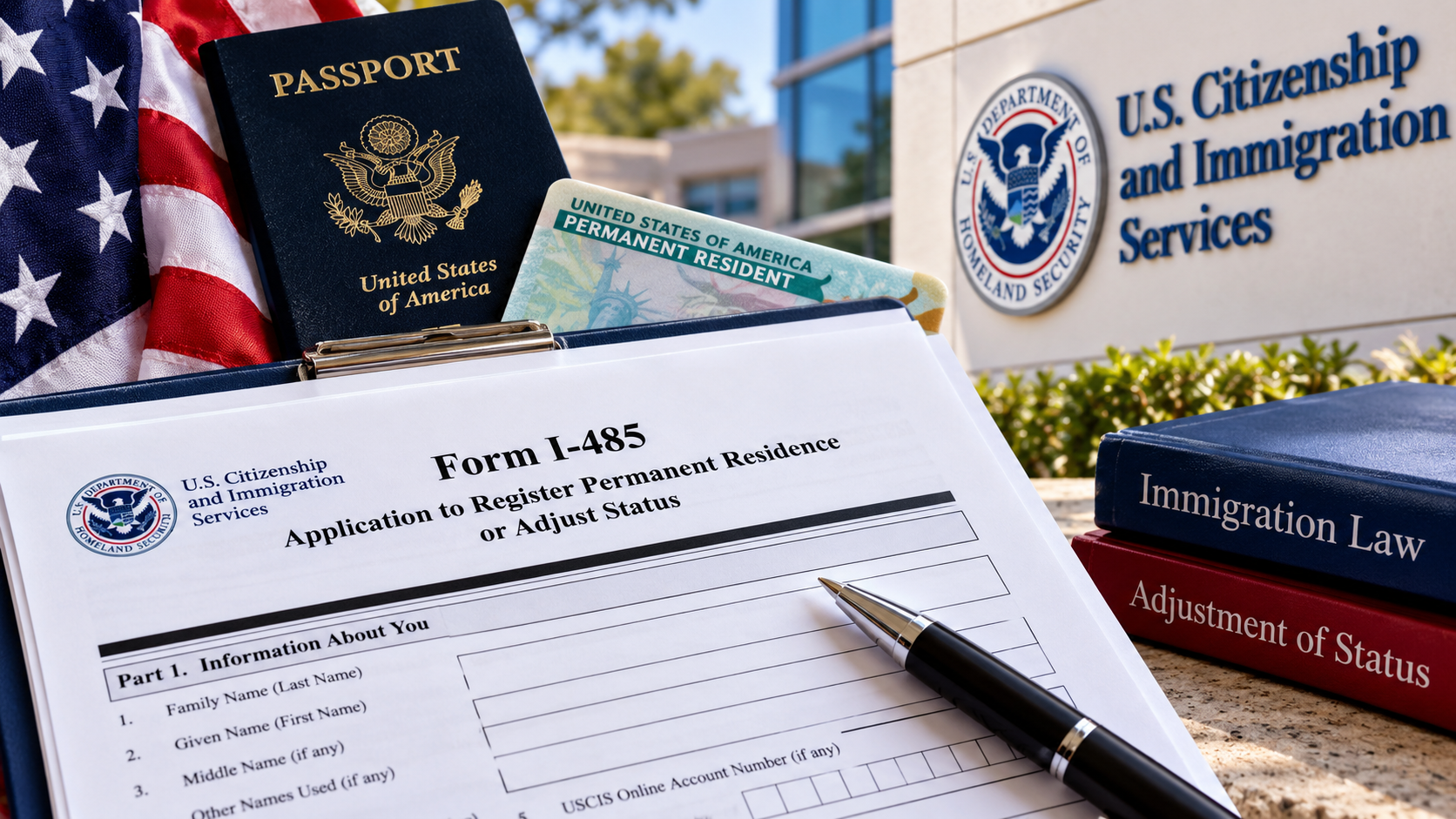
Adjustment of Status Trends in 2026: What We Are Seeing at USCIS
Adjustment of status has changed considerably in 2026.
Some of those changes are positive. USCIS’s own national statistics show that family-based Form I-485 applications have been moving faster than they did only a few years ago.
At the same time, faster processing should not be confused with a simpler or more forgiving adjustment-of-status process.
USCIS has implemented a new public-charge framework, introduced a new edition of Form I-485, and continues to operate under an enforcement policy that can make the consequences of an unsuccessful application more significant for certain applicants.
From the USCIS data, policy changes, and adjustment-of-status cases we are following in 2026, several trends stand out.
Applicants considering adjustment of status should understand both sides of the picture: USCIS may be processing many family-based cases more quickly, but careful analysis before filing remains extremely important.
For a general explanation of adjustment eligibility and the Form I-485 process, applicants can also review our Complete Guide to I-485, Adjustment of Status.
KEY TAKEAWAYS
- USCIS data show that family-based adjustment-of-status cases have been moving faster nationally in 2026 than in recent fiscal years.
- Faster processing does not necessarily mean that USCIS is applying less scrutiny to eligibility, admissibility, marriage evidence, or immigration history.
- A new public-charge framework took effect on September 18, 2026 and may affect many family-based adjustment applicants.
- Applicants filing now must use the current edition of Form I-485 and comply with current USCIS filing requirements.
- USCIS’s current Notice to Appear policy means that an unsuccessful immigration application can carry additional consequences for certain applicants who are removable from the United States.
- Applicants should evaluate potential problems before filing rather than assuming they can simply address them later if USCIS raises an issue.
Trend #1: Family-Based Adjustment Cases Are Moving Faster Nationally
One of the more noticeable trends in USCIS’s published data is that family-based adjustment-of-status processing has improved nationally.
USCIS reports that the national median processing time for family-based Form I-485 applications during fiscal year 2026, through June 30, was approximately six months.
For comparison, USCIS reported a national median of approximately 7.4 months in fiscal year 2025 and 8.9 months in fiscal year 2024.
That is a meaningful improvement.
However, a national median should not be interpreted as a promise that an individual case will be decided within six months.
Processing time can vary depending on the USCIS field office, whether an interview is required, whether USCIS requests additional evidence, whether the underlying immigrant petition remains pending, background checks, and issues particular to the applicant’s case.
A case involving an RFE, a complicated immigration history, questions concerning admissibility, or additional investigation can take substantially longer.
Trend #2: Faster Processing Does Not Mean Less Scrutiny
Applicants should be careful about drawing the wrong conclusion from faster processing statistics.
A shorter national processing time does not mean that the substantive requirements for adjustment of status have become easier.
USCIS must still determine whether the applicant qualifies to adjust status and whether the applicant is admissible to the United States.
Depending on the case, that can require examination of the applicant’s manner of entry, immigration history, prior applications, unauthorized employment, criminal history, prior removal or immigration proceedings, fraud or misrepresentation issues, financial circumstances, medical admissibility, and other potential grounds of inadmissibility.
Marriage-based applicants have an additional issue: the marriage itself must qualify under immigration law, and USCIS must be satisfied that the marriage was entered into in good faith rather than primarily to obtain an immigration benefit.
In other words, faster adjudication does not eliminate the underlying legal analysis.
Trend #3: Public Charge Has Become a Much More Important Part of the Analysis
One of the largest adjustment-of-status changes of 2026 took effect on September 18.
The Department of Homeland Security rescinded the public-charge regulations that had governed cases since 2022 and returned to a broader framework that gives USCIS officers greater discretion to evaluate whether certain applicants are likely at any time to become a public charge.
For applicants subject to the public-charge ground of inadmissibility, USCIS may consider factors including:
- age;
- health;
- family status;
- assets, resources, and financial status;
- education and skills; and
- other relevant circumstances.
The new framework can also permit consideration of a broader range of means-tested public benefits received on or after September 18, 2026.
This does not mean that receiving a public benefit automatically results in denial. Public charge remains an individualized determination based on the totality of the circumstances.
However, it does mean that financial circumstances should now receive considerably more attention when preparing certain family-based adjustment applications.
We discuss this subject in substantially greater detail in our 2026 Public Charge Rule for Adjustment of Status article.
Trend #4: Technical Filing Requirements Matter
Another development in 2026 is the importance of making sure the adjustment application being filed is actually the current application USCIS will accept.
USCIS introduced a new edition of Form I-485 in connection with the September 18 public-charge changes.
An applicant should not assume that an I-485 downloaded or prepared several months earlier remains usable.
Using an obsolete form edition, omitting required signatures, submitting incomplete pages, mixing pages from different form editions, or failing to comply with current filing requirements can result in the application being rejected before USCIS ever reaches the merits of the case.
This is especially important where an applicant is relying on a particular filing date, visa availability, concurrent filing, or another time-sensitive immigration circumstance.
CAUTION
A denied adjustment-of-status application may have consequences beyond simply losing the Green Card application.
Under USCIS's current Notice to Appear policy, USCIS no longer categorically exempts classes or categories of removable applicants from potential immigration enforcement.
Depending on the applicant's immigration status and circumstances, USCIS may issue a Notice to Appear or refer a matter for enforcement after an immigration benefit request is denied.
This does not mean that every denied I-485 results in immigration court proceedings. But applicants who may be removable should understand their immigration history and potential exposure before filing rather than assuming that the only possible consequence of denial is losing the filing fee.
Before mailing an adjustment application, verify the current form edition and filing requirements directly with USCIS.
Trend #5: The Consequences of Filing a Weak Case Can Be Greater
The current environment makes pre-filing analysis particularly important.
Adjustment of status has sometimes been treated as though it were primarily a paperwork exercise: complete Form I-130, complete Form I-485, obtain the medical examination, submit financial sponsorship documents, and wait for USCIS to schedule an interview or issue a decision.
That approach can overlook the most important question:
Is there anything in the applicant’s history that creates a legal or factual problem before the application is filed?
For example, an applicant may need to examine:
- whether the applicant was inspected and admitted or paroled;
- whether there is reliable evidence establishing the applicant’s entry;
- prior immigration applications or petitions;
- prior statements made to immigration officials;
- unauthorized employment or status violations;
- arrests, citations, or criminal history;
- possible fraud or misrepresentation;
- prior removal proceedings or orders;
- public-charge or financial issues; and
- in marriage cases, whether the evidence adequately demonstrates a bona fide marriage.
These issues are not necessarily fatal to adjustment of status. Some may not create an immigration problem at all. Others may have exceptions, waivers, or legal arguments available.
The important point is that the issue should be identified before USCIS identifies it.
Trend #6: Applicants Should Expect a More Individualized Review
Another theme running through the 2026 changes is the importance of the individual facts of the case.
The new public-charge framework expressly requires a totality-of-the-circumstances analysis. Marriage-based cases continue to turn heavily on the facts demonstrating whether the relationship is genuine. Admission and parole issues may depend on what documentation exists regarding an entry that occurred many years ago.
Even two applicants who appear to have very similar cases on paper may have materially different immigration histories.
One applicant may have entered with a visa and overstayed. Another may have entered without inspection. One may have previously filed an immigration application containing inconsistent information. Another may have an old arrest that was dismissed. One marriage may have years of traditional joint documentation, while another legitimate couple may have very little documentation because one spouse does not yet have a Social Security number or access to financial accounts.
Those differences matter.
For that reason, applicants should be cautious about relying too heavily on the experience of a friend or relative whose Green Card application appeared similar.
What Has Not Changed in 2026?
Despite the changes discussed above, the basic purpose of adjustment of status remains the same.
Eligible applicants who are physically present in the United States may seek lawful permanent residence without completing immigrant visa processing abroad when the applicable requirements are satisfied.
Family-based adjustment of status remains available, including to many spouses, parents, and children of U.S. citizens.
Marriage-based applicants must still establish that the underlying marriage is legally valid and bona fide. Applicants must still establish admissibility or qualify for any necessary waiver or exception. And the applicant still bears the burden of establishing eligibility for the immigration benefit requested.
The 2026 trends therefore should not be viewed as a reason for otherwise eligible applicants to avoid adjustment of status.
Rather, they are a reason to approach the application carefully, use current forms and requirements, and identify potential problems before the case is submitted.
What Should Adjustment Applicants Do in 2026?
Before filing Form I-485, applicants should review the current USCIS requirements rather than relying on instructions, forms, or online information obtained months earlier.
They should also examine their immigration history as a whole rather than focusing exclusively on completing the current forms.
That review may include obtaining I-94 records, prior immigration filings, court records, immigration court records, criminal dispositions, tax and financial documents, marriage evidence, and other materials relevant to the particular case.
Applicants should also make sure the information provided on Form I-485 is consistent with prior immigration filings and accurately answers what USCIS is asking.
The principal trend we see in 2026 is not that adjustment of status has become impossible. It is that careful preparation matters more than ever.
This article reflects USCIS data, policies, and published rules available as of October 4, 2026. Immigration policies and procedures can change, and applicants should verify current requirements before filing.
How GS LAW Can Help
Adjustment of status involves more than completing Form I-485.
GS LAW, APC assists individuals and families with adjustment-of-status matters, including marriage-based Green Card applications. Our review can address whether adjustment of status is available, admission or parole, immigration history, prior filings, Form I-130, Form I-485, Form I-864 sponsorship requirements, public-charge concerns, criminal or immigration issues, medical examination requirements, marriage evidence, and preparation for USCIS interviews.
Where a potential issue exists, identifying it before filing can allow the applicant to understand the risk, determine whether additional evidence is needed, and evaluate whether an exception, waiver, or other legal strategy may apply.
If you are considering filing for adjustment of status in 2026, contact GS LAW, APC to schedule an immigration consultation.